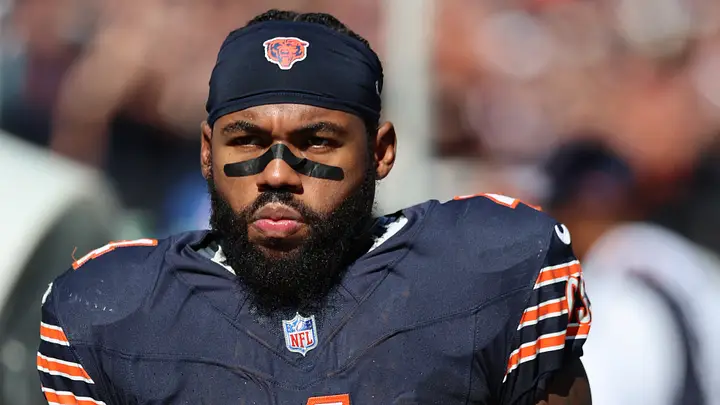
Chicago Bears running back D’Andre Swift finds himself at the center of a hypothetical locker-room controversy following Chicago’s disappointing defeat to the Green Bay Packers, as questions mount over the team’s execution, offensive struggles, and ability to respond under pressure.
The Chicago Bears have been left searching for answers after their disappointing performance against the Green Bay Packers, with frustration among supporters continuing to grow following the defeat. In a hypothetical scenario that would send shockwaves through the organization, running back D’Andre Swift could find himself confronting difficult questions about the performance of his teammates and the collective responsibility for Chicago’s struggles.
The loss has renewed attention on the Bears’ offensive consistency, the pressure facing the team’s supporting cast, and the need for improved communication on the field. Although no verified statement confirms that Swift has blamed his teammates, the possibility of internal frustration following a disappointing divisional matchup raises an important question: how much responsibility should individual players accept when a team fails to deliver?
For Chicago, the defeat represents more than a disappointing result on the scoreboard. It provides another opportunity to examine the weaknesses that can prevent a talented roster from performing as a cohesive unit.
A Disappointing Afternoon Against a Divisional Rival
Games against the Green Bay Packers carry special significance for the Chicago Bears. The rivalry is one of the NFL’s most historic, and every meeting brings enormous expectations from supporters who want to see their team establish dominance.
That makes a disappointing defeat particularly difficult to accept.
When Chicago struggles against Green Bay, criticism rarely remains limited to one player or one position. Coaches, quarterbacks, running backs, receivers, and defensive players can all come under scrutiny when the team fails to execute its game plan.
In the hypothetical scenario surrounding Swift, the running back’s frustration would be understandable if he believed that missed opportunities, inconsistent blocking, dropped passes, or defensive mistakes prevented the Bears from competing effectively.
However, football is a collective sport. Even an outstanding individual performance cannot guarantee victory when other areas of the team fail to function properly.
For Swift, the challenge would be finding a way to express disappointment without damaging relationships inside the locker room.
Why D’Andre Swift’s Role Matters
Swift plays an important role in Chicago’s offensive system because of his ability to contribute as both a runner and a receiver.
A versatile running back can help an offense in several ways. He can carry the football between the tackles, exploit openings outside the offensive line, provide a passing option when the quarterback faces pressure, and help create opportunities that force defenders to account for multiple threats.
When an offense operates effectively, these responsibilities complement one another.
However, when blocking breaks down or passing plays fail to develop, a running back can find himself working with limited opportunities. Defenders may close running lanes quickly, forcing him to make difficult decisions before reaching the line of scrimmage.
The same problem can occur in the passing game. If the quarterback is under pressure or receivers struggle to create separation, the offense may fail to sustain drives.
This is why blaming one player for a disappointing team performance can be misleading.
If Swift were to express frustration with his teammates in this hypothetical situation, the central issue would not simply be whether he had enough touches. It would be whether Chicago’s offensive players were consistently fulfilling their responsibilities.
The Teammate Question: Accountability or Finger-Pointing?
One of the most difficult situations in professional football occurs when players believe their teammates are not performing to the expected standard.
Every player wants to win. Professional athletes also understand that poor performances can affect their reputation, playing time, contract negotiations, and standing with supporters.
When expectations are not met, frustration can develop quickly.
A running back might feel that his opportunities are being wasted because of missed assignments. A quarterback might believe that receivers are not completing routes correctly. Offensive linemen might argue that the entire unit needs to improve its communication.
Defensive players can face similar disagreements when missed tackles or coverage breakdowns allow opponents to score.
Nevertheless, there is a difference between demanding accountability and publicly attacking teammates.
Accountability involves identifying mistakes, accepting responsibility, and working toward improvement. Finger-pointing shifts responsibility away from the individual and places it entirely on someone else.
For the Bears, the productive response to a disappointing performance would be an honest assessment of what went wrong, followed by a commitment to correcting those problems.
If Swift were to criticize his teammates publicly, supporters would naturally want to know whether his comments reflected legitimate concerns about execution or unnecessary frustration after a loss.
Without an actual statement from Swift, however, it would be unfair to claim that he has accused anyone of letting the team down.
Chicago’s Offensive Struggles Under the Spotlight
Offensive football depends on timing, discipline, and coordination.
A successful running play often requires several players to execute their assignments almost simultaneously. The offensive line must create an opening, the tight end or receiver may need to block a defender, and the running back must identify the available space.
A single missed assignment can disrupt the entire play.
Passing attacks are equally dependent on coordination. The quarterback must read the defense, receivers must run their routes correctly, and the offensive line must provide sufficient protection.
When these elements fail to work together, drives can end prematurely.
For Chicago, improving offensive consistency would require more than asking Swift to produce bigger numbers. The team would need to examine its blocking schemes, play selection, execution, and ability to adjust when the opposition changes its defensive approach.
Coaches would also need to determine whether the problems stem from individual mistakes, tactical decisions, or a combination of factors.
The objective should be to create an offense that does not depend on one player rescuing the team whenever difficulties emerge.
Swift can be an important contributor, but the Bears need their entire offensive unit to function effectively if they want to compete consistently.
The Pressure on the Bears’ Locker Room
Defeats against divisional rivals can intensify pressure inside an NFL locker room.
Supporters expect players to compete aggressively, coaches face questions about their decisions, and athletes must respond to criticism while preparing for the next opponent.
That environment can create tension, particularly when the same mistakes appear repeatedly.
Still, successful teams understand that unity becomes especially important after difficult results.
Players must be willing to challenge one another, but those conversations should lead to solutions rather than lasting divisions. A team that spends too much time arguing over responsibility risks carrying its problems into subsequent games.
The Bears would benefit from a clear evaluation of their performance, with each player identifying what could have been done better.
For Swift, that would mean reviewing his own decisions alongside the performances of the offensive line, quarterback, receivers, and coaching staff.
Taking responsibility does not require a player to ignore mistakes made by others. It requires everyone to recognize that improvement starts with an honest assessment of their own contribution.
What Must Change Before Chicago’s Next Game?
The Bears’ response to a disappointing loss would be more important than the frustration generated immediately afterward.
First, Chicago would need to improve its execution. Avoidable penalties, missed assignments, turnovers, and failed third-down conversions can prevent an offense from building momentum.
Second, the coaching staff would need to evaluate whether its offensive approach gives Swift and the other playmakers sufficient opportunities to succeed.
Third, the team would need to improve communication. Players who understand their assignments and trust their teammates are better positioned to react when the defense presents an unexpected challenge.
Finally, Chicago would need to demonstrate greater consistency. A promising drive or an impressive individual play means little if the offense cannot sustain its performance throughout the game.
These adjustments require cooperation from the entire roster.
No running back, quarterback, or receiver can solve every problem independently. The team must identify its weaknesses and address them collectively.
Bears Fans Demand a Response
Chicago supporters have every reason to expect a stronger response after a disappointing performance against Green Bay. The rivalry carries considerable emotional weight, and fans want evidence that the team can learn from its mistakes.
Swift’s importance to the offense naturally places him under the spotlight. His production, involvement in the passing game, and ability to create opportunities will continue to attract attention.
But the discussion should remain focused on verified performances rather than unconfirmed accusations.
If genuine comments emerge from Swift or another Bears player, they could provide valuable insight into the team’s mood and its assessment of the defeat. Until then, claims of a locker-room confrontation or direct criticism of teammates should not be presented as established facts.
The most important question for Chicago is not whether one player is willing to criticize another. It is whether the team can turn disappointment into measurable improvement.
Final Verdict: Chicago Must Find Answers Together
The hypothetical possibility of D’Andre Swift expressing frustration with his teammates highlights a broader issue facing any NFL team after a disappointing loss: individual talent cannot consistently overcome collective mistakes.
Chicago needs reliable execution, stronger communication, effective coaching decisions, and contributions from every part of the roster.
Swift’s role is significant, but the running back should not be expected to carry the entire offense on his shoulders.
If the Bears want to put a disappointing performance behind them, the answer lies in accountability rather than blame. Every player must examine his own performance, recognize where the team fell short, and help create a better result in the next game.
For now, the suggestion that Swift has publicly blamed his teammates remains unverified. The real story is Chicago’s need to respond to adversity and demonstrate that the defeat can become a turning point rather than the beginning of a prolonged struggle.
The question facing the Bears is simple: can Chicago turn its frustration into a stronger performance, or will the same problems continue to follow the team?
Bears supporters will be watching closely for the answer.